
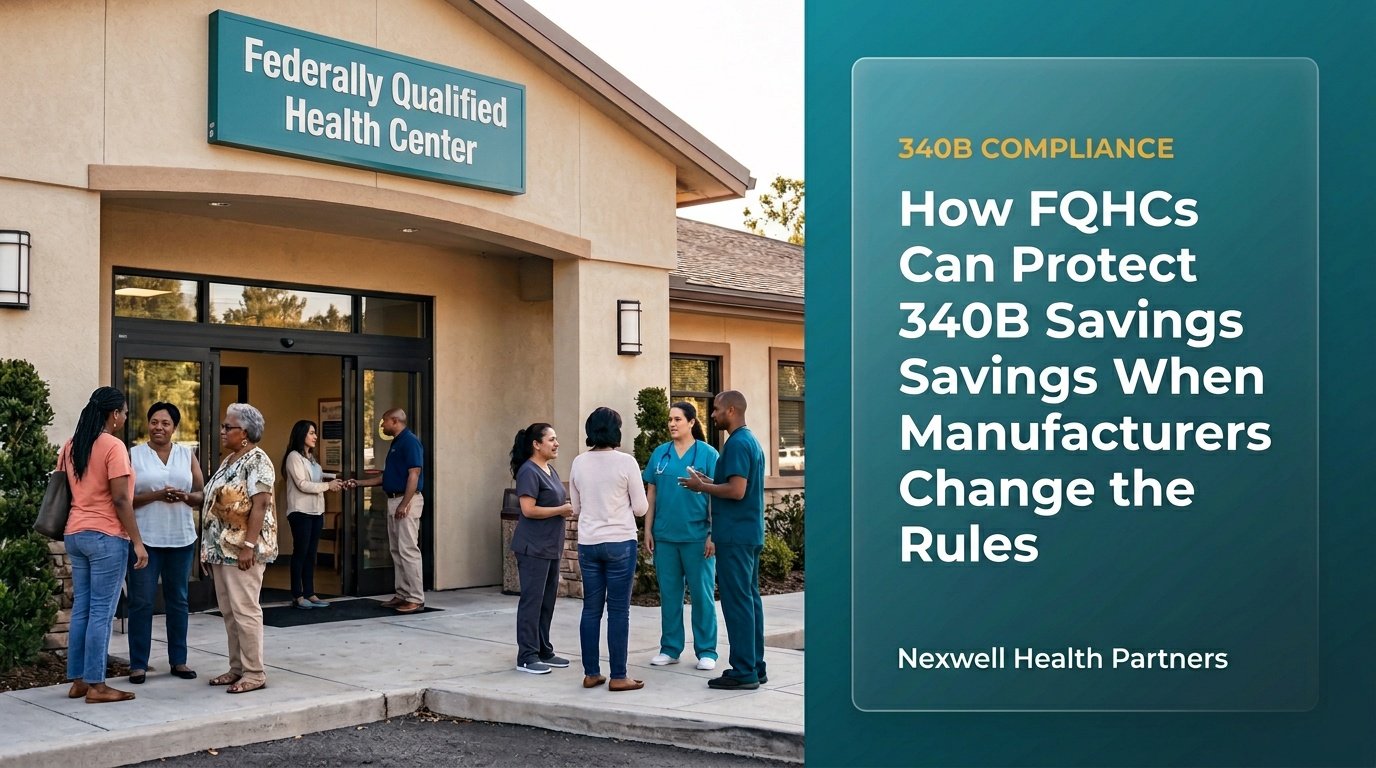
340B Savings Fund the FQHC Mission
For Federally Qualified Health Centers, the 340B Drug Pricing Program is not a profit center. It is the financial mechanism that enables sliding-fee-scale care, pharmacy services for uninsured patients, and expanded clinical programs that Medicaid and grant funding alone cannot support.
When manufacturers restrict 340B pricing, the impact hits FQHCs directly in their ability to serve patients. Unlike hospitals that may absorb 340B revenue changes within larger operating budgets, FQHCs depend on 340B savings to fund core services.
The manufacturer restriction landscape now includes 39 companies with varying policies, the aftermath of the AHA v. Kennedy ruling, and a pending HRSA Request for Information on rebate models. Protecting your 340B program requires operational discipline across multiple fronts.
Understanding Your Exposure
Start with a drug-by-drug analysis of your 340B utilization by manufacturer. Identify which manufacturers have imposed restrictions, what those restrictions require, and how much 340B savings are at risk for each one.
For most FQHCs, a handful of high-cost specialty drugs generate a disproportionate share of 340B savings. If the manufacturers of those specific drugs have imposed restrictions, your exposure may be concentrated in a small number of products.
This analysis should include both in-house pharmacy dispensing and contract pharmacy arrangements. Manufacturer restrictions typically target contract pharmacy dispensing first, but the trend toward requiring claims-level data for all dispensing channels is expanding.
Complying with Claims-Level Data Requirements
Most manufacturer restrictions require covered entities to submit claims-level data through platforms like 340B ESP to maintain 340B pricing at contract pharmacies. The data submission process requires matching patient prescriptions to 340B-eligible encounters, which demands tight integration between your pharmacy system, your EHR, and the data submission platform.
For FQHCs, the patient definition is a critical compliance element. A 340B-eligible patient is someone who receives a health care service from a provider employed by or under contract with the FQHC, where the FQHC maintains records demonstrating the individual is a patient of the entity. Prescriptions written by providers who are not part of your FQHC scope of project do not qualify.
Ensure your claims-level data accurately reflects only 340B-eligible prescriptions. Submitting data that includes ineligible prescriptions creates compliance risk with both the manufacturer and HRSA.
Optimizing In-House Pharmacy Operations
As contract pharmacy access becomes less reliable, FQHCs with in-house pharmacies have a significant advantage. In-house dispensing gives you direct control over 340B inventory, eliminates the contract pharmacy split, and is less vulnerable to manufacturer restrictions.
If your FQHC does not currently operate an in-house pharmacy, evaluate the feasibility. The startup costs are significant, but the long-term 340B revenue protection and the clinical benefits of integrated pharmacy services often justify the investment.
For FQHCs with existing in-house pharmacies, focus on maximizing capture rates. Every 340B-eligible prescription that leaves your pharmacy for a retail chain is potential savings lost. Patient education, prescription transfer programs, and convenient pharmacy hours all improve capture rates.
Responding to the HRSA RFI
HRSA’s Request for Information on the use of rebates to effectuate 340B ceiling prices represents a potential fundamental shift in how the program operates. If rebates replace upfront discounts, FQHCs would need to purchase drugs at full price and wait for manufacturer rebates, creating cash flow challenges that could force smaller health centers to reduce pharmacy services.
Your RFI response should include specific data on how a rebate model would affect your FQHC’s cash flow, patient access, and program sustainability. Generic responses carry less weight than facility-specific financial modeling.
The deadline is April 20, 2026. If you have not started your response, begin now. The future of your 340B program may depend on it.
Disclaimer
This article is for educational purposes only and does not constitute legal advice. FQHCs should consult qualified counsel regarding 340B compliance strategies and manufacturer restriction policies.
━━━━━━━━━━━━━━━━━━━━━━━━━━━━━━━━━━━━━━━━━━━━━━━━━━
Nexwell Health Partners provides management services, telehealth solutions, and compliance support for safety-net hospitals, FQHCs, and specialty practices. Contact us to schedule a consultation.
Sources